
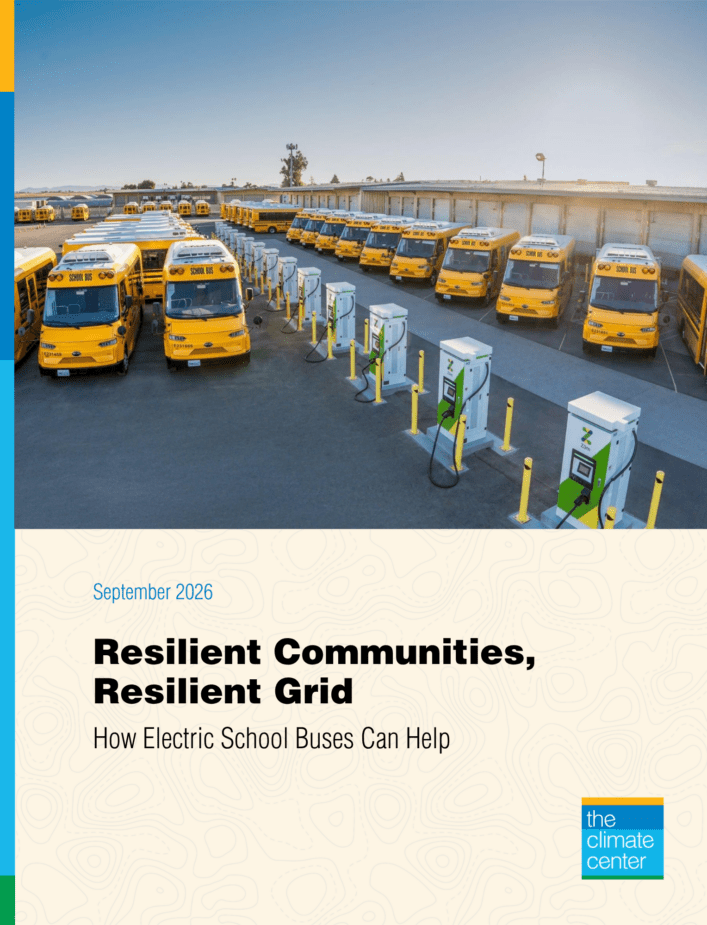
Bidirectional electric school buses (ESBs) have enormous untapped potential to improve student health, enable community energy resilience during power outages, and build a more reliable grid through vehicle-grid integration. To realize these multiple benefits, California must enact policy to prioritize ESBs to enhance electricity affordability, resilience, and reliability.
While the primary purpose of ESBs is to safely transport students, they can also provide numerous grid benefits since they are essentially “batteries on wheels.” ESBs can use smart or managed charging to optimize charging for cost savings and grid impacts, and bidirectional charging to actually export power to the grid or to a building.
While we are far from realizing the full potential of these grid benefits, California can pioneer the use of bidirectional electric school buses at scale, starting in disadvantaged communities.
ESBs alone will not solve all of California’s electricity grid challenges, but ESBs should be recognized for their health, cost, and climate benefits.
While this white paper provides an introduction to ESBs, vehicle-grid integration, and bidirectional ESBs, it also covers the context of California’s prior work in vehicle-grid integration. This report identifies four main barriers to and possible policy solutions for scaling up bidirectional ESB projects in the state: funding and financing, interconnection, education and awareness, and interoperability.
More broadly, this white paper is intended to equip policymakers, advocates, and school districts with the information needed to support ESBs and to accelerate opportunities for ESBs to serve as community energy resilience hubs.
This report was produced with support from the Clif Family Foundation.

Kurt Johnson
Director, Vehicle-Grid Partnership

Pooja Agarwal
Community Energy Resilience Policy Manager