
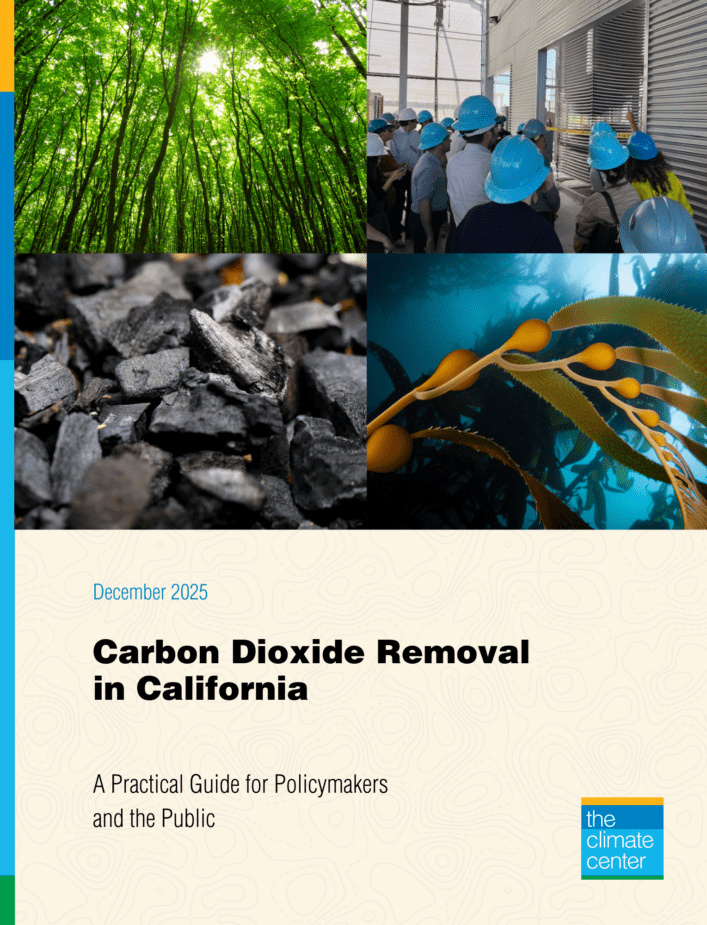
California is entering a pivotal moment in its fight against the climate crisis, one that demands not only accelerating the reduction of greenhouse gas emissions, but also confronting carbon pollution left behind since the Industrial Revolution. These long-lived legacy emissions will continue to impact the climate, even when society has successfully decarbonized across sectors.
The United Nations Intergovernmental Panel on Climate Change (IPCC) has made it clear that, in order to stabilize our climate, society will need to both greatly reduce emissions and also remove hundreds to thousands of gigatons of carbon dioxide already released into the atmosphere.
Meeting California’s goals will therefore require a coordinated, dual strategy:
- Accelerating decarbonization across all sectors, and
- Responsibly scaling Carbon Dioxide Removal (CDR) to remove residual and legacy carbon emissions.
Carbon Dioxide Removal (CDR) encompasses nature-based, hybrid, and industrial methods that remove legacy emissions from the atmosphere and store them in products or in geological, terrestrial, and aquatic reservoirs. This paper explores key topics in the world of CDR, from various CDR pathways to potential financing mechanisms and how environmental justice must be the guiding principle for future policies and projects.
Key policy recommendations
To ensure the responsible deployment of CDR in California, The Climate Center recommends the following policy priorities for state decision-makers:
- Keep CDR separate from emissions reductions. Count CDR solely toward California’s dedicated carbon removal targets (7 million metric tons by 2030; 75 million metric tons by 2045), not toward the state’s 85 percent emissions-reduction requirement.
- Strengthen Community Benefits Agreements for industrial CDR. Include community rights of refusal and restitution, protections for frontline communities, multilingual notices and opportunity for input, and best-practice engagement standards.
- Adopt strict regulations on the transport and storage of carbon dioxide in all of its states. Require science-based setback distances from industrial CDR projects and carbon dioxide pipelines, odorized carbon dioxide, and clean-energy powered operations. Uphold bans on Enhanced Oil Recovery (EOR), require strong emergency response planning and leakage remediation plans, limit transport distance, and require a full CEQA review, including cumulative impacts.
- Increase funding for CDR research and development. Support studies that clarify impacts, risks, and potential pathways to scaling effective CDR solutions.
- Continuously fund and expand investment in nature-based solutions (NBS). Advance AB 1757 targets to scale NBS and deliver statewide carbon removal and resilience benefits.
- Refine Monitoring, Reporting, and Verification (MRV). Ensure MRV protocols for all CDR strategies provide accurate, additional, and transparent carbon removal accounting.
- Develop long-term, fossil-free funding mechanisms for CDR. Establish financing tools — such as compliance markets, extended producer responsibility, procurement, and tax incentives — that do not rely on offsets or perpetuate the use of fossil fuels.
- Fund ongoing partnerships with environmental justice and community organizations. Support community engagement throughout the lifecycle of CDR projects to ensure industrial CDR delivers meaningful local benefits and centers the local community.
Related Resources

Baani Behniwal
Carbon Drawdown Director