
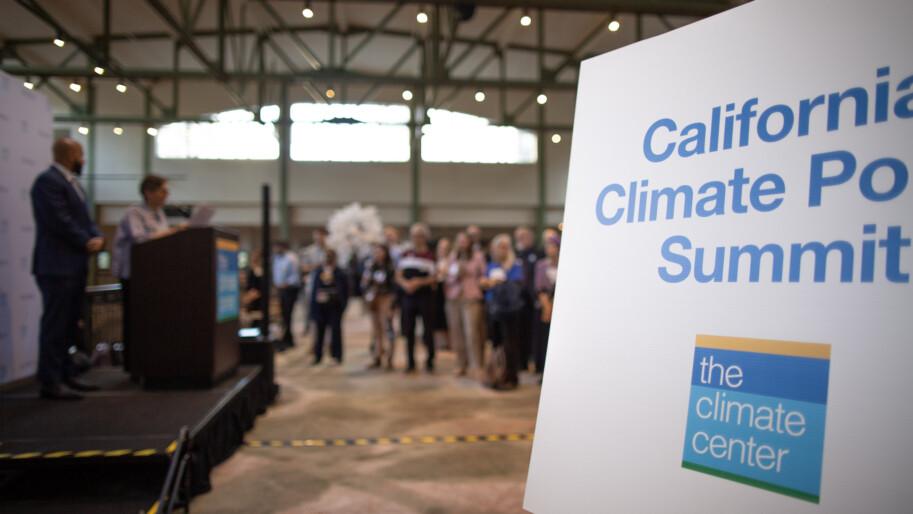
On April 13, 2026, more than 400 elected officials, climate activists, business leaders, environmental justice advocates, scientists, and policy experts gathered for the fifth annual California Climate Policy Summit. Thank you to all of you who joined us and supported this event!
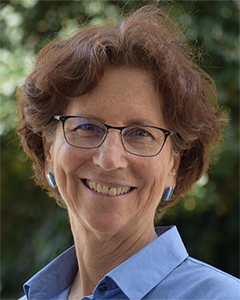
Read The Climate Center CEO Ellie Cohen’s opening remarks below:
Welcome everyone, and thank you for being here today to collaboratively build power for accelerated, equitable climate action in California. Many thanks to The Climate Center staff for all their hard work organizing today’s summit!
Today marks not only the fifth annual California Climate Policy Summit, but also The Climate Center’s 25th anniversary. Thank you on behalf of our team for being here and for working collaboratively to secure a climate-safe future for all.
Our collective work to slow and reverse the climate crisis is incredibly urgent. It is not an exaggeration or hyperbole to call it a climate emergency. It is truly an existential threat to life as we know it on our planet. Thanks to the relentless burning of fossil fuels and destruction of our soils, forests, and habitats, our home planet is in the emergency room and struggling on life support.
New science shows that there has been a significant acceleration in the rate of global warming over the past decade. We all know it. We are living it. The current rate of warming is higher than in any decade since records began in 1880.
And as that greenhouse effect around the Earth grows, we are warming the oceans so much, not just on the surface but deep down. The oceans experienced the highest heat content ever in human history this past year, threatening more weather extremes, our health, and our food security. Remember that we humans and other life forms on the surface directly suffer only a small fraction of that heat energy building up because 91 percent is absorbed by the oceans. Remember to pay attention to the oceans — what happens there does not stay there.
We are also passing global tipping points that can lead to devastating and irreversible changes in our climate system. Since last year’s California Climate Policy Summit, scientists confirmed that we have passed tipping points with tropical coral reefs.
We are now on the verge of tipping points with tropical rainforests as well as the Atlantic Meridional Overturning Circulation (AMOC), an ocean conveyor belt that moves heat from the Caribbean up toward Greenland and around to Europe, moderating Europe’s weather. A new study found that this current is slowing down and could shut down entirely in the next few decades. This is one of the most ominous climate risks for Europe and the world, with huge impacts on global heat transfer.
All of this is happening in our current political context of dysfunction and greed in the United States, with a federal administration that is anti-science, anti-democracy, pro-oil, and pro-profit-at-any-expense.
The most recent egregious act — repealing the endangerment finding so that the Environmental Protection Agency (EPA) no longer officially recognizes greenhouse gases as threats to public health and welfare — strips the legal basis for federal regulation of carbon emissions. This eliminates mandatory vehicle emissions standards, reduces EPA regulatory authority under the Clean Air Act, and acts as a major deregulatory move for fossil fuel industries.
I am personally grateful to Governor Newsom for fighting back against the Trump administration. Together with Attorney General Bonta, they have filed 54 lawsuits against the Trump administration, including on energy and climate issues.
But I am personally disappointed that, as Governor Newsom runs for president, his main audience seems to be voters in purple states, and he has stepped back from being a climate champion. Last fall, he vetoed AB 740, the virtual power plant bill, which had been approved by the legislature with near-unanimous and bipartisan support. And then he signed SB 237 into law, allowing more oil drilling in Kern County. This was in light of refinery closures, but alternative solutions exist. Unacceptable!
The Climate Center recently published a report showing that the state gave away a whopping $28 billion to corporate polluters from 2013 to 2024 through its pollution trading and biofuels programs. Those funds were intended for clean transportation and other climate solutions. This, too, is unacceptable!
It’s unacceptable, especially as we just faced the hottest and driest March ever recorded here in California and the West. Some locations even broke records for April and May. You all know that extreme heat kills and sickens more people than any other form of extreme weather. The March heat dome was 800 times more likely because of climate change and would have been virtually impossible without it.
Now scientists are predicting a super El Niño this summer and into next year, which is expected to break heat records and drive more extreme floods, with deadly consequences for so many, especially the most vulnerable.
Never forget that every fraction of a degree of warming is significantly worse. But the opposite is also true. Every fraction of a degree of warming prevented will prevent untold suffering. We can always make a difference!
Thankfully, there is some progress happening around the world:
- Globally, a record $2.3 trillion was invested in clean energy in 2025, more than double the money invested in fossil fuels.
- Solar is the cheapest form of electricity globally, and battery prices are plummeting.
- China sold more EVs than gas cars in 2025, and China sold more EVs in 2025 than all cars sold in the United States during the same year.
- The United Kingdom had its first full year with no coal power in 2025.
- Coal power use dropped for the first time in China and India after setting clean energy records.
- Renewables accounted for almost 90 percent of all new energy built worldwide.
- Renewable energy use outpaced coal as the primary energy source for electricity for the first time globally.
Here in the United States, despite all the challenges from the current administration, renewables produced almost 26 percent of total U.S. generation in 2025. That’s expected to increase in 2026.
And here in California, solar with battery storage is now the state’s largest source of electricity, more than gas. California reached over 2.5 million new zero-emission vehicle (ZEV) sales by the end of 2025, far surpassing the state’s original target of 1.5 million ZEVs by 2025.
So what are we going to do in California, the fourth-largest economy in the world, a Big Oil state, and an environmental and environmental justice state?
We absolutely cannot afford to simply defend our past accomplishments from attack. We must push forward, commensurate with the urgency of the latest science and our experienced climate reality. We must accelerate climate action now. For moral, health, and economic reasons, California must continue its bold leadership.
And we urgently need policies enacted that move us forward. Here are some policy priorities to do just that:
- SB 913 (Becker), the Clean Local Power Act, will ensure local clean energy resources are fully valued in the energy market and compensated so that the state has enough affordable, clean electricity during peak demand times. It is time to use the resources we already have!
- SB 1282 (Becker), the Battery Integration and Grid Reliability Act, will encourage the use of smart, managed EV charging and bidirectional EVs to support grid reliability, resilience, and affordability while also authorizing the California Energy Commission to set standards.
- AB 2184 (Wilson) will secure ongoing, annual state funding to invest in nature-based climate solutions and sustainable agricultural practices, which will help achieve the 81 targets established as a result of AB 1757 (C. Garcia, 2022). This will help ensure food and water security while providing numerous other co-benefits, including much greater resilience to drought, fires, floods, and heat waves. Remember, as renowned climate scientist Johan Rockstrom recently said, “There is no pathway to climate stability or sustainable development without keeping nature intact.”
- Finally, AB 2672 (Hart) will replace the oldest, most polluting gas cars with clean EVs and reduce air pollution by assessing a fee on out-of-state gasoline importers. This will help stabilize gasoline supply during emergencies, prevent price spikes, and provide crucial funding for clean transportation.
Other policies we will discuss today include advanced geothermal, carbon dioxide removal, methane reduction, and using electric school buses as resilience assets. We will also address big questions like how do we develop data centers in a way that keeps rates affordable and protects the environment and our communities? How do we invest in climate priorities when we have structural budget deficits?
Enacting these policies will demonstrate California’s climate leadership, make us more resilient, grow our economy, create new jobs, and keep us innovating for a climate-safe future for all.
How do we get these done? We get them done by working together. So let’s keep working together. Today we will learn together, act together, and push forward together to secure a climate-safe future for all!